Showing posts with label science. Show all posts

Wednesday, October 19, 2011

A Letter to Readers - Conferences

Fine Readers of PiPT, 


Sorry for the long delay in blog posts! It always stresses me out when I haven't written something in more than four days, and it's been a good 3 weeks since this site got any love, so you can imagine my state. But I think that it was worth it, because I was hard at work getting ready to attend...

Wednesday, September 14, 2011

The God Particle


The Higgs boson.
...I don't even know.


You may have heard of the “Higgs boson particle” in the news lately. It’s the thing that CERN is working so hard on this year, sending out news reports daily, it seems. In reality, the Higgs boson is one of the only theoretical fundamental particles that hasn’t been observed yet, and even more important, it’s the key to a grand unification of Physics theory.

But... what is it?

Wednesday, August 31, 2011

The Fundamentals, Part 3: The Strong Force

Part three is our first venture into relatively obscure physics. I’d reckon that not many people could accurately describe what either weak or strong forces do. Luckily, you won’t be one of those people. 
Years ago, when quantum science was first being explored, physicists started discovering a couple of very, very small pieces of matter and energy that made up everything, particles like protons, electrons, and neutrons. They called these the ‘elementary particles’ because of their special status as the building blocks of the universe. All of this progress led to more accurate models of the atom, and it was finally deduced that all atoms contained a nucleus in the center with a certain number of protons and neutrons, as well as an electron cloud surrounding this core. 

And for this, there was much rejoicing.
But how did the protons and neutrons stay together?


Thursday, August 25, 2011

The Fundamentals, Part 2: Electromagnetism, a.k.a. "The positive side has the bump, right?"


Ah, electromagnetism. This fundamental interaction of matter is so much more important than most would believe. Like gravity, the effects of electromagnetism have always been known by humankind, in one form or another. However, it wasn’t until way, way later that we found out what it truly was, or how integral it is to the existence of... well, everything. It took a man by the name of James Clerk Maxwell to get science on its way. He published his Treatise on Electricity and Magnetism in 1873, pointing out several interconnected properties between the two phenomena, like: 
Point 1: Electric charges of different sign (positive, negative) attract, and like ones repel. The same goes with magnetic poles: north pulls south, and pushes away other norths. 
Point 2: Running an electric current through a wire creates a magnetic field. Likewise, moving a magnet through a loop of wire creates an electric current. 
What he had described was the newly understood phenomena called... electromagnetism. 

Wednesday, July 27, 2011

I Can't Believe They're Not Forces!

If you’ve ever taken a Physics course, you may have learned about Newton’s 3 Laws of Motion. In case it’s been a while:
  1. An object in motion stays in motion
  2. The force of an object is equal to the mass multiplied by the acceleration (F=ma)
  3. For every action, there is an equal but opposite reaction.
These are the rules upon which Classical Physics was founded. They are taught in grade school like they are the end-all and be-all of motion in our Universe, and one can certainly do amazing things with them. However, think about this interesting mind experiment: you slide a puck on a frictional rotating table.
That’s it. That’s the mind experiment. You can picture that, right? Because Newton’s Laws can’t.

...pause for dramatic effect...

Tuesday, July 26, 2011

'The Tides', or 'Things that are so much more complicated than they seem'

So, it's the middle of the summer. That time of year when TV stations play Christmas in July specials and the Earth decides it wants to try and set fire to anyone who walks outside by bombarding them with UV radiation. And what better way to celebrate this fact than going to the beach? 


The beach, as it turns out, is full of physics. In fact, the beach wouldn’t even be there without physics. It’s the motion of the tides that eroded the rocks that originally created the border between sea and land, turning everything into sand. And of course, what makes the tides come in and out? The gravitational pull of the moon. 


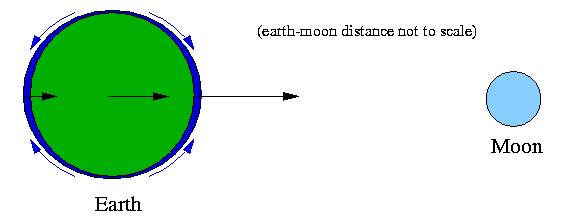
As romantic as it sounds, the pull of the moon on the sea is actually fascinating. At high tide, water is pulled towards the moon ever-so-slightly. This subsequently creates a low tide on the sides of the Earth, the places that the water is being drawn from. Yet, the opposite side of the Earth also has high tide, since the effect of the moon goes straight through the Earth! 


This MS Paint drawing just blew my mind. 

Tuesday, July 19, 2011

The Universe ain't what it used to be.

Do you remember that post I wrote on antimatter about a week ago? Near the conclusion, I speculated that there could be whole antimatter galaxies that science has yet to discover, and thus blew your mind with physics. Well, someone decided to take it a step further. The physicist Dragan Hajdukovic recently published a paper describing an alternate Big Bang theory, one that I found fascinating. In his theory, the universe eventually stops expanding, shrinks down, and then switches all of its matter into antimatter. 

....what.

That’s right: we would live in an antimatter universe. Let’s Tarantino this theory and see how Dragan came to this shocking conclusion.

Saturday, July 16, 2011

Graphene = Physics Magic

It seems to get better and better every day. Every other news report that comes out describes it as something that outlasts, outshines, and outruns every other material out there. But first.... what is it? 
Graphene is a 2-dimensional sheet of carbon molecules, packed close together in a hexagon pattern reminiscent of chicken-wire (something a surprising number of nanotech specialists are familiar with). It’s a fairly recent development in physics, not because scientists didn’t know single sheets existed, but because they didn’t know they could be isolated from the bigger 3D graphite. Theoretically, 2D crystals should not exist; the thinner a film of atoms gets, the lower its melting point (remember that temperature is simply the vibration of atoms. The faster the vibration, the more unstable our chicken wire can get). By the time you get to 2D, there should be an indefinite melting point. Hence, no graphene. 
But obviously, science messed up.

Wednesday, July 13, 2011

Antimatter: everything you'll never be


If any of you are familiar with Dan Brown’s book Angels and Demons, or if you've been around any physics anything in the past few years, then you might know a little bit about something called antimatter. You get one thing, grab its natural opposite, smash them together, and things explode. But really, what is antimatter? How does that even happen? Well, I'm glad you asked.


As common in almost all of the most interesting physics concepts, the science was predicted before it was discovered. It was no different with antimatter. In 1928, Paul Dirac published a paper outlining the connections between Albert Einstein’s Theory of Relativity, which worked on a large scale, and Erwin Schrodinger’s equation of quantum physics, which worked on a small scale. Now, understand: Dirac was freakin’ brilliant. His mathematics was spot-on, and his explanation connecting these two branches of physics made perfect sense if one analyzed his equations. 


Perfect Sense.

Tuesday, July 12, 2011

News: Google Global Science Fair

I realize that the purpose of my blog is to explain science in a friendly way, but sometimes science is better told by others. This is the case at the Google Global Science Fair. These kids are just incredible; check out the finalists, as well as their amazing works, at the project's website:


Also, in addition to the ridiculous opportunities these students were provided for their amazing work, they got giant Lego trophies. That's something.

Wednesday, July 6, 2011

Flux Capacitors are so overrated

The concept of time has fascinated mankind for a long… time. Our lives are focused on its flow: when to grow food, when to sleep, when to mate, when to bundle up. We reminisce and anticipate. The flow of time is not only part of our lives, it is our lives, and our deaths, and everything in between. This all-encompassing feel to time is what makes it remarkable. Yet, until the turn of the century (excluding big thinkers like H.G. Wells) time was realistically seen as an immovable force that could never be manipulated or changed. It was Albert Einstein himself who put an end to that notion when he published his Theories of Relativity.
Now, though this blog does not have the time to go into his thought process in detail*, Einstein’s basic message was that the three dimensions of space, as well as the singular dimension of time, were not separate entities, but rather woven into one another, creating what we now call: ‘space-time’. 
Stay with me, now. 

Thursday, June 30, 2011

Little Glowy Things

See these?
Shiny.

These are called quantum dots. They are incredibly tiny semiconductors, the applications of which are nearly endless. And you’ve probably never heard of them. 

Sunday, June 26, 2011

Hair of the Dog

Everyone has that friend who goes out every night of the weekend (starting on Thursday) and seemingly spends at least half of their paycheck attempting to get as drunk as possible. This is not necessarily a bad thing; socially, clubbing is a great way to bond with friends: if not out of enjoyment, then out of collective fear of that one guy in the corner who keeps giving you those looks. You know the one.
Yet when I see someone partying hard, I don’t think about how they feel then, but fast-forward to the next morning when the hangover sets in. Do they even know what their bodies have been through? The struggles their motor skills went through to get them back to their apartment? How they’ve just given themselves the equivalent of a drawn-out concussion? My guess is, probably not.

Saturday, June 18, 2011

Mutants!

The recently-released X-Men: First Class (which, for the record, was an excellent film) depicted genetically unique ‘mutants’ with skills so amazing that some of their members saw themselves as a new and improved species. It’s wonderful to think that a lucky few might one day be able to create magnetic fields with a wave of our hand, or hypnotize with a stare, but sadly these things are not even physically impossible, but evolutionarily impractical. Even if nature dictated that it was time for one man to shoot high-powered lasers from his eyes, what evolutionary purpose would this serve?
Thinking a little about that, we’re led to an even bigger question: in what way could humans keep evolving? It sounds like an incredibly pompous question, especially coming from a person that could be outrun, outswam, outflew, and outlived by many other members of the animal kingdom. Yet there is some logic behind it. Humans are unique from any other animal through the way that they utilize the environment around them; more often than not, instead of adapting to it, we make it adapt to us. 
In Soviet Russia...

Thursday, June 16, 2011

Have a heart...

For most of my life, I’ve had minor heart palpitations. They’ve never been very serious, at their worst making me mildly uncomfortable for a few seconds, but they've always thrown me a little off my guard. An irregular heartbeat is an uncomfortable thing to experience; that pumping rhythm is there one’s entire life, and the body doesn’t react well when the tempo switches up. 
But what if there was no tempo? Enter science. NPR recently covered a story about an artificial heart that doesn’t act like a heart at all… at least in the traditional sense. In the past, artificial hearts like the Jarvik 7 were designed to mimic the natural processes of the originals – mainly, the electrically-stimulated 'pumping' action – and act as a total replacement for the damaged organs. In most cases, though, damage wasn’t severe enough to cause a total shutdown, and so a total heart replacement would actually do more harm than good.
...in some cases.


Wednesday, June 15, 2011

Physics is fascinating, I swear.

Physics is fascinating. I’m a physicist, so I’m a bit biased, but I always experience a sense of wonder when experiencing the world around me through such terms. 
Now, this love of science is not universal. Some have big issues with the whole idea; they usually have some valid points: 
1. I’m not a science person. It’s really never interested me in the least.
2. Math.
3. Why do I want to know how to calculate a ball’s flight path? No, honestly, why?
4. I tried to get into it in high school, but my teacher/class/notebook wasn’t good enough. 


Fig. 1: Fun.


Well, I have come up with some rebuttals. You see, in all of its supposed complication and intricacy, Physics is nothing more than the science of change. And, as many of us have experienced first-hand, change happens all the time; anyone who notices this is already a type of scientist. Just like the world around us, change itself is ever-changing, you could say. 
Or not. I probably wouldn’t, it’s a strange turn of phrase. But you understand. 
The goal of this blog is to share with you, dear reader, my sense of wonder and, more importantly, the reason why I’m a scientist. Most teachers fail to put the science in context, which is 100% of the fun. I’ll even admit, the fact that a ball goes up and down is not exciting in itself; anyone who took basic physics in high school will tell you that. Yet it was the idea that prompted Galileo Galilei, Isaac Newton, Albert Einstein, and hundreds of other great minds to think long and hard about what makes the world go ‘round (in several cases, literally) and transform our universe from one of chance to one of intricate order, from one of blind faith to one of incredible utility. 

This transformation is never emphasized in introductory classes, even though it was the thing that got me and several other people I know hooked on physics, and more broadly science, in the first place. Moreover, observing how other things change, like the body, the stock market, or human emotions, make one just as scientific as a physicist, and those who excel at this study are just as capable as the great minds described above. 
Some would say that comparing a great writer/economist/artist and a great physicist is like comparing apples/bananas/kiwis and oranges, and in a way I suppose they’re right. But while the skill set might be different, the basic concepts that physicists use are the exact same concepts used in every other facet of academia. Anyone who doesn’t like physics, but is able to devote themselves to knowledge in some other way, is unknowingly a kind of physicist themselves. My hope is that by sharing my experiences in science with you, you’ll find a little beauty in it yourself. 

Except for the math part. There’s no getting past that one (See Fig. 1)


-----


Subscribe to the RSS feed: http://physicsispeople.blogspot.com/feeds/posts/default?alt=rss